
Why Does My Pee Smell Like Fish? What It Means and What to Do
A fishy smell usually has a specific and treatable cause. Here's what's behind it, how to tell which one is yours, and when to see a doctor.
Written by
Thomas Nelson
Published on
July 16, 2026

Overview
A fishy smell usually has a specific and treatable cause. Here's what's behind it, how to tell which one is yours, and when to see a doctor.


If your pee smells fishy, you've probably already run through the obvious question: was it something I ate? There’s a good chance you’ve landed here because you landed on no and it keeps happening.
A fishy smell usually has a specific cause, and most of them are common and treatable. The smell by itself won’t tell you which one, but what’s happening alongside it can provide some clues.
First, let’s understand the chemistry, because it makes the rest make sense.
Trimethylamine: the chemistry behind the fishy smell
Trimethylamine, TMA for short, is the chemical responsible for the odor of spoiling seafood. And your body makes it every day.
Certain foods contain choline and related compounds like carnitine. When you eat them, your gut bacteria break those compounds down and release TMA. It's absorbed into your bloodstream and carried to your liver, where an enzyme called FMO3 converts it into TMAO, a nearly identical molecule that's completely odorless.
That odorless version leaves in your urine, and you never notice a thing. In people without a metabolic issue, well over 90% of it makes that conversion.
TMA is worth understanding because it's behind a couple of the causes below, including a rare condition that's built entirely around that conversion failing.
TMA isn't the only thing that can make urine smell fishy. Odor is subjective, infections produce all sorts of volatile compounds, and fish-like odors can come from other substances too. So this is a useful piece of the puzzle, not the whole puzzle board.
Fishy discharge: bacterial vaginosis and trichomoniasis
Is the smell coming from your urine, or are you noticing it while you urinate? That’s an important distinction to nail down.
If you have a vagina and there's any unusual discharge alongside the smell, the odor may not be coming from your urine at all, and that changes what you should do next.
Two common conditions cause fishy-smelling discharge:
1. Bacterial vaginosis is a shift in the balance of vaginal bacteria. It's very common, it isn't caused by poor hygiene, and it isn't sexually transmitted. Research going back decades identified TMA as the primary contributor to its characteristic odor — the same molecule, made by different bacteria — though other compounds like putrescine and cadaverine contribute as well.
2. Trichomoniasis is a sexually transmitted infection caused by a parasite. It can produce thin discharge that's clear, white, yellowish, or greenish with a fishy smell, often with itching, irritation, or discomfort urinating. Roughly 70% of people who have it notice no symptoms at all.
Unfortunately, you can't reliably tell these apart yourself. They present similarly. The CDC is explicit that trichomoniasis can't be diagnosed on symptoms alone. Treatment can overlap, oral metronidazole is commonly used for both, but the diagnosis matters because trich is an STI, partners need treatment, and follow-up retesting is recommended. Having BV also raises your risk of trich.
So if there's discharge with the smell, the move isn't to figure out which one it is from an article. It's a quick test. Both are common, both are curable, and neither says anything about you as a person.
One thing worth knowing: the odor is often more noticeable after sex or around your period. That's chemistry, not hygiene. TMA sits in a balance between a form that stays in solution and a volatile form you can smell, and pH tips that balance. Semen and menstrual blood are both alkaline compared to the normally acidic vagina, which shifts more of it into the form you notice.
Your Body is Always Talking
You do your business. You see your data.
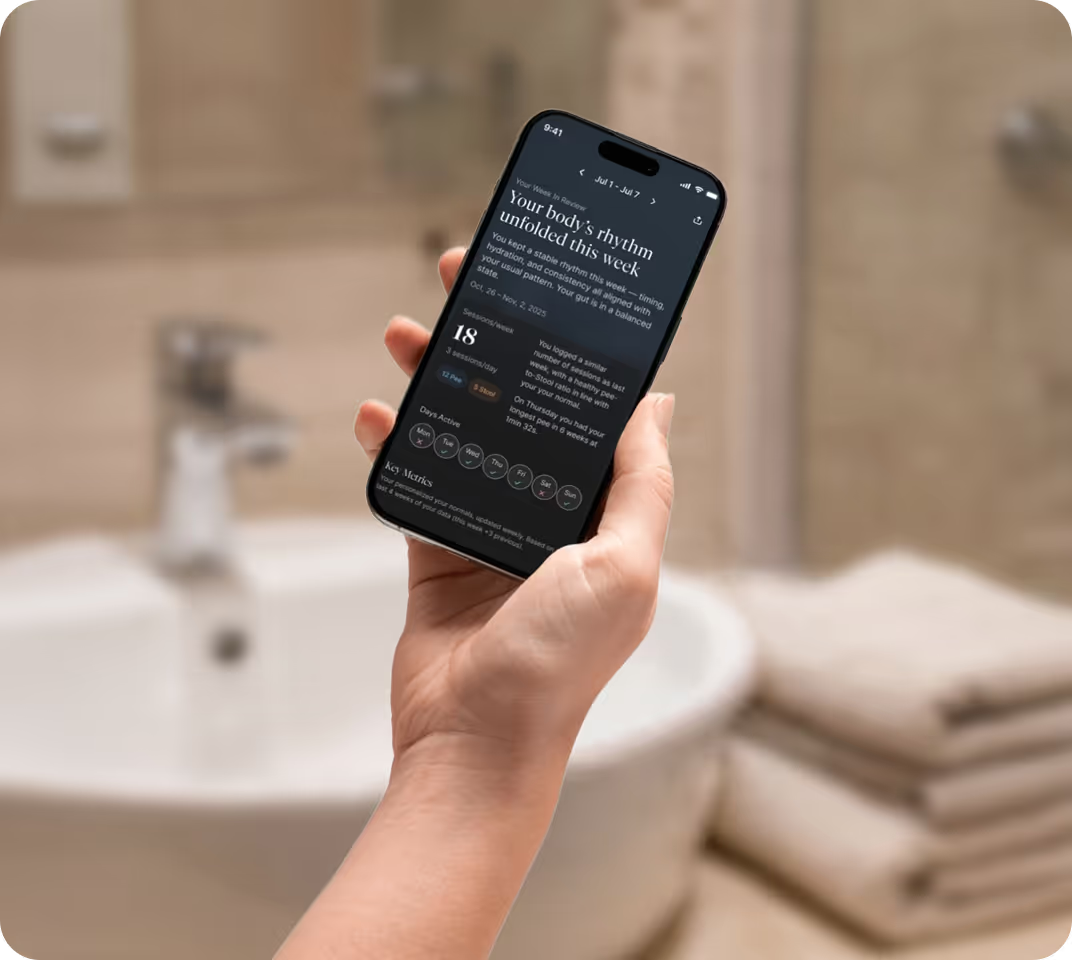
Throne is a smart sensor that clips onto your toilet and reads every session automatically — stool consistency, frequency, hydration, and regularity — without any logging. It turns the patterns you would never notice into personalized insight about your gut health and hydration.
Urinary tract infections
A UTI can change how your urine smells, and prostatitis can do something similar in men.
The honest nuance: odor alone is a weak signal. Plenty of people with strong-smelling urine have no infection, and plenty of infections don't smell like much. What actually points at a UTI is the smell plus the company it keeps: burning when you pee, urgency, going constantly, cloudy urine, or pelvic pain.
Smell and burning together is worth a call to your doctor. Smell alone, on a day you happened to eat a lot of seafood, is a different situation.
Food and supplements
Diet can produce a fishy smell, though it's less of a slam dunk than the internet suggests.
The clearest cases involve large loads. High-dose choline or carnitine supplements can do it. So can a lot of marine fish or shellfish, which are a bit different from other foods here: they contain TMAO directly, which your gut bacteria can convert straight back into TMA, skipping a step.
But most people eat fish, eggs, and beans routinely without ever noticing anything, so ordinary meals aren't a reliable explanation for a smell that's genuinely new. If you loaded up on shellfish or started a new supplement and noticed a change, that connection is worth making. If nothing in your diet changed, look elsewhere on this list.
Dehydration doesn't create a smell, but it concentrates your urine, which can make an existing one more noticeable. If your pee is dark, drinking more water is a reasonable first move regardless.
Trimethylaminuria, or fish odor syndrome
This is the rare one, and it's where that FMO3 conversion breaks down. Without a fully working enzyme, TMA builds up and leaves through every available exit.
It looks different from a one-off:
- It recurs, though the odor is often episodic rather than constant. It can even be undetectable at a doctor's appointment, which is part of what makes it so frustrating to get diagnosed.
- It affects sweat and breath, not just urine.
- It's strongly triggered by choline-rich food, and severity can also shift with hormones, stress, exercise, and illness.
It's genetic and there's no cure, but it's genuinely manageable with dietary changes, and having a name for it matters enormously to people who've spent years being told they're imagining it. If this pattern sounds like your life rather than your Tuesday, raise it with a doctor and ask about TMAU by name.
Advanced liver or kidney disease can also cause elevated urinary TMA through mechanisms distinct from inherited FMO3 deficiency. Worth knowing that these secondary causes typically show a different chemical signature than true FMO3 deficiency, which is one way doctors tell them apart. Neither shows up as an isolated smell with no other symptoms.
How to tell which one is yours
The smell won't sort this out. What's happening alongside it might:
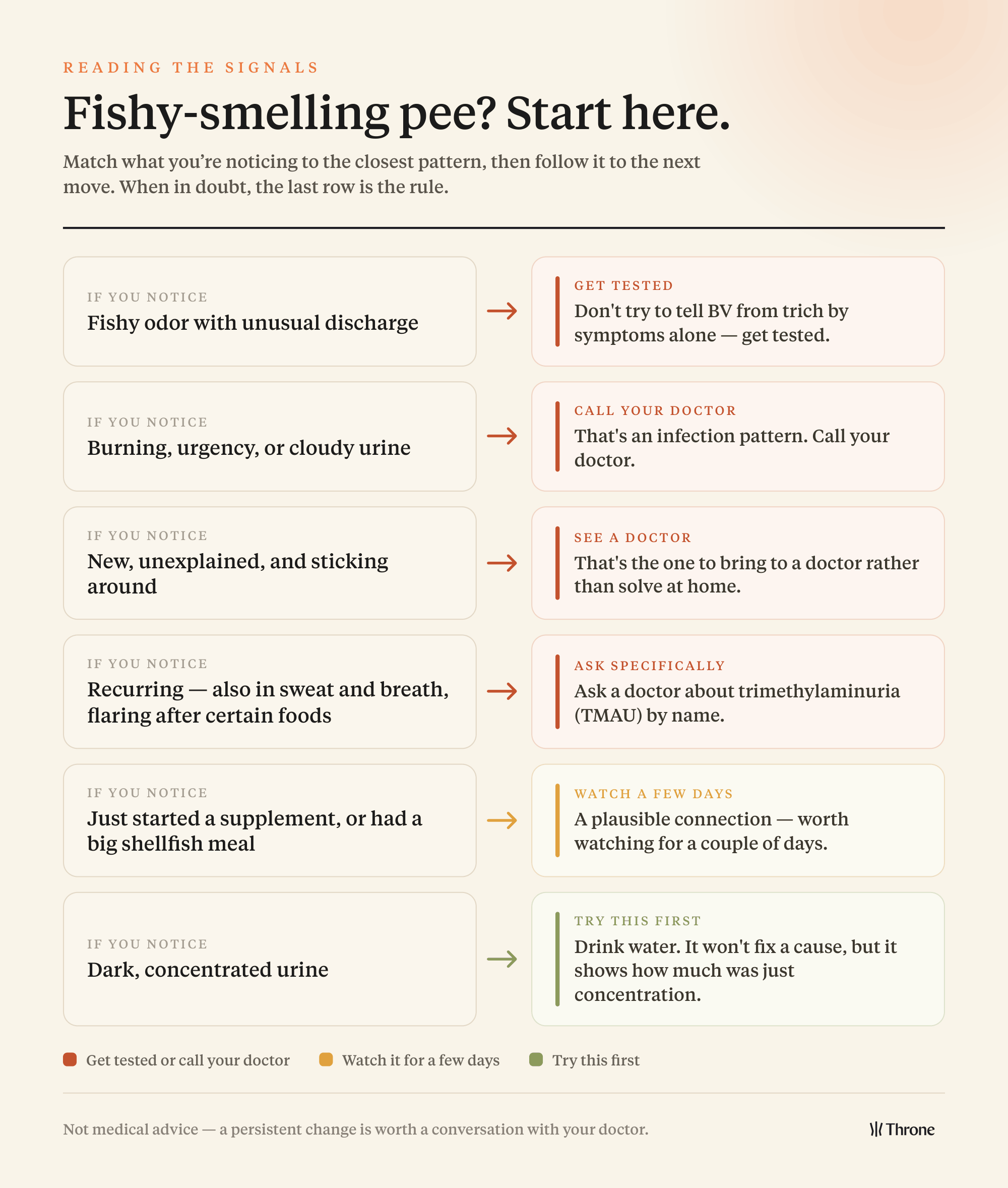
- Fishy odor with unusual discharge? Don’t try to distinguish BV from trich by symptoms alone. Get tested.
- Burning, urgency, cloudy urine? That's an infection pattern. Call your doctor.
- Started a new supplement, or had a big shellfish meal? That's a plausible connection worth watching for a couple of days.
- Dark urine? Drink water. It won't fix a cause, but it will tell you how much of this was concentration.
- Recurring, in your sweat and breath, flaring after certain foods? Ask a doctor about trimethylaminuria specifically.
- New, unexplained, and sticking around? That's the one to bring to a doctor rather than solve at home.
The useful question isn't "what could this be." It's "what else is going on?"
When to see a doctor
Worth an appointment: any unusual discharge, a smell that persists more than a few days without an obvious explanation, or a smell that keeps returning in a pattern.
More urgent: burning or painful urination, blood in your urine, fever, or back or flank pain. Those suggest an infection worth treating promptly rather than waiting out.
There's no prize for solving this yourself. Most causes here are common, and nearly all can be treated or managed once identified.
Telling a one-off from a pattern
Notice what the chemistry implies: the first step in that whole chain is your gut bacteria. The smell in your urine started with microbes doing what they do. Your body is more interconnected than it lets on, and it's constantly producing signals most of us never learn to read.
Smell is subjective and nearly impossible to recall accurately by the next morning, which is exactly what makes it hard to tell a fluke from a trend. Knowing what's normal for you is most of the game, and Throne reads what's actually happening session by session, so you're working from a real baseline instead of a hazy memory.
For the other smells and what they mean, we cover the full range in our guide to why your pee smells.
Frequently Asked Questions
Q: Why does my pee smell like fish?
A: Several things can cause it. If there's unusual discharge, the smell may be coming from bacterial vaginosis or trichomoniasis rather than your urine. If there's burning or urgency, an infection is more likely. Large amounts of shellfish or high-dose supplements can do it. And rarely, a metabolic condition called trimethylaminuria is behind it. The smell alone won't tell you which; the symptoms alongside it will.
Q: Does fishy-smelling urine mean I have a UTI?
A: Not on its own. Odor alone is a weak indicator. A UTI is much more likely if the smell comes with burning, urgency, cloudy urine, or pelvic pain.
Q: Why does the fishy smell get worse after sex or during my period?
A: That pattern points toward vaginal discharge rather than your urine. The compound responsible becomes easier to smell as pH rises, and both semen and menstrual blood are alkaline compared to the normally acidic vagina. It's chemistry, not hygiene, and the underlying causes are treatable.
Q: What is fish odor syndrome?
A: Trimethylaminuria, a rare genetic condition where the enzyme that converts trimethylamine into its odorless form doesn't work properly. It recurs rather than happening once, it's often triggered by choline-rich foods, and it affects sweat and breath as well as urine. It's manageable with dietary changes.
Brand, J. M., & Galask, R. P. (1986). Trimethylamine: The substance mainly responsible for the fishy odor often associated with bacterial vaginosis. Obstetrics & Gynecology, 68(5), 682–685. https://pubmed.ncbi.nlm.nih.gov/3763085/
Centers for Disease Control and Prevention. (2021). Sexually transmitted infections treatment guidelines, 2021. MMWR Recommendations and Reports, 70(4), 1–187. https://www.cdc.gov/std/treatment-guidelines/trichomoniasis.htm
Mitchell, S. C., & Smith, R. L. (2001). Trimethylaminuria: The fish malodor syndrome. Drug Metabolism and Disposition, 29(4), 517–521. https://dmd.aspetjournals.org/content/29/4/517
Phillips, I. R., & Shephard, E. A. (2015). Primary trimethylaminuria. In GeneReviews. University of Washington, Seattle. https://www.ncbi.nlm.nih.gov/books/NBK1103/
DISCLAIMER: This content is for informational purposes only and is not intended as medical advice. Throne products are not medical devices and are not intended to diagnose, treat, cure, or prevent any disease. Consult your physician with any health-related questions.