
High-Fiber Foods for Better Digestion: A Simple Shopping List
A practical, digestion-focused guide to high-fiber foods, including which type of fiber helps constipation vs loose stools and a shopping list organized by grocery aisle.
Written by
Thomas Nelson
Published on
July 13, 2026
Overview
A practical, digestion-focused guide to high-fiber foods, including which type of fiber helps constipation vs loose stools and a shopping list organized by grocery aisle.


Most of us are walking around short on fiber and don't know it. Roughly 90 to 97% of adults fall short of the recommended intake, which sits around 30 grams a day for most people. The good news is that closing the gap doesn't take a massive diet overhaul. A few swaps and knowing which foods actually deliver will make all the difference.
This guide is built for adding fiber simply and sustainably: what to grab at the store, how much fiber it carries, and which kind of fiber helps depending on how your poops are doing.
Two kinds of fiber, and why the difference matters for your gut
This is the part most fiber lists skip, and it's the part that actually helps you. Fiber is commonly divided into two broad types, and they do different jobs.
If you tend toward constipation, gradually increase fiber, but don’t assume insoluble fiber is always best. Coarse wheat bran, whole grains, and vegetables can add stool bulk, but psyllium has stronger evidence for making stools softer, bulkier, and easier to pass. Start slowly, since a sudden fiber increase can cause gas and bloating, and take fiber supplements with the amount of fluid directed on the label. Drinking extra water may help if you are dehydrated, but more water alone does not reliably fix constipation.
If you tend toward loose, urgent stools, gel-forming soluble fiber can absorb water and give stool more structure. Psyllium has the best evidence and can help normalize both loose and hard stools. Oats may help too, while foods such as bananas and applesauce can be easy to tolerate but are less well studied as treatments for diarrhea.
Most whole foods contain both types, so a varied plate covers your bases. The targeting above just helps when your gut needs a nudge one way or the other.
The shopping list, by grocery aisle
When you’re thinking about adding more fiber to your diet, it can be easy to go wild at the grocery store and buy a bunch of high-fiber foods. But you don’t need to overhaul your cart. Pick two or three high-fiber foods you already enjoy and build from there:
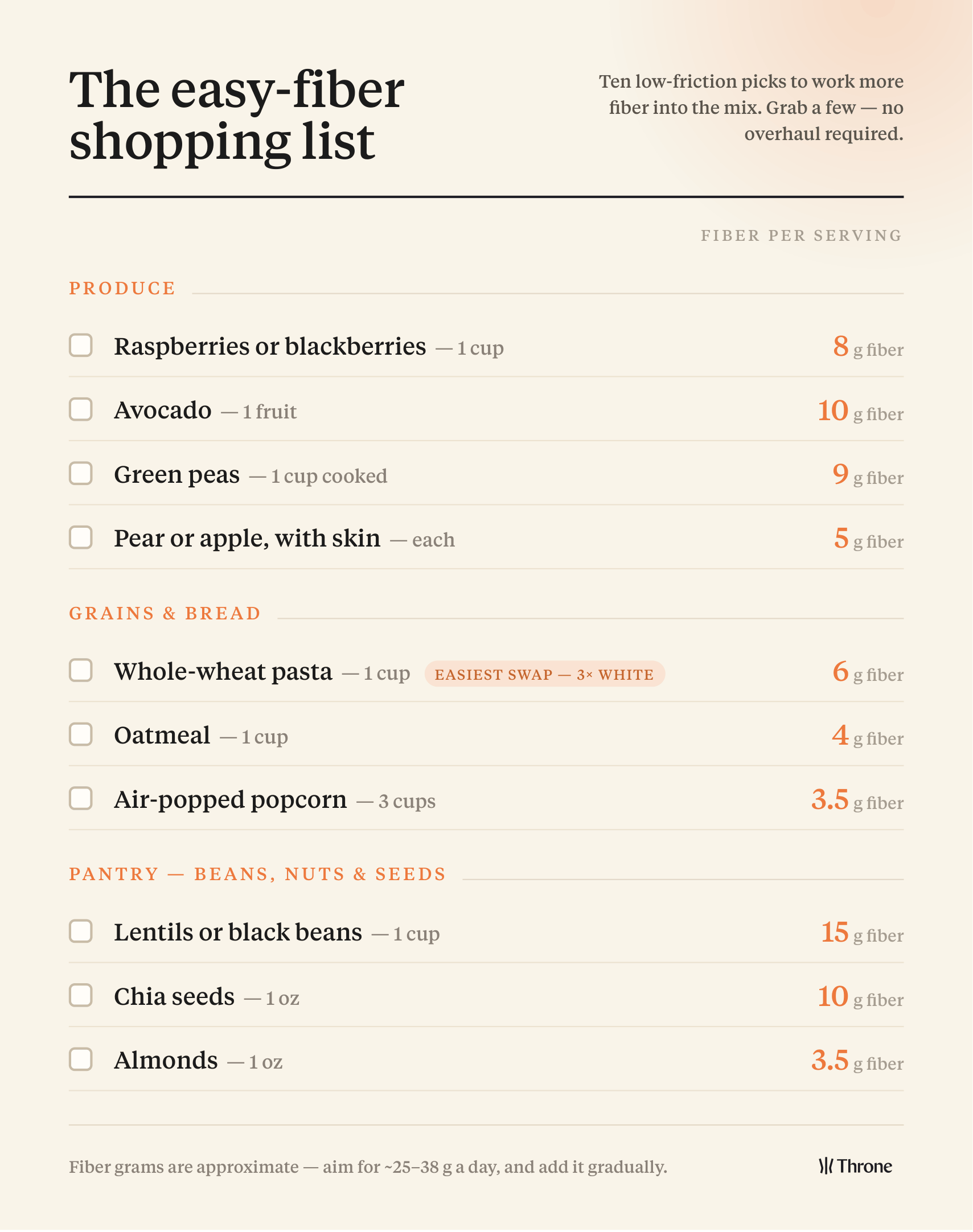
Beans and lentils are the standouts here. They are among the richest everyday whole-food sources of fiber, and they bring plant protein along for the ride.
How to add fiber without the bloating
The one mistake that makes people quit: going from low fiber to high fiber overnight. Do that and you're much more likely to experience gas, cramping, and bloating. Two rules keep it comfortable:
Ramp up slowly. Add fiber gradually, perhaps one new serving or about 3 to 5 grams at a time, and give your gut several days to adjust before adding more.
Stay adequately hydrated. Fiber supplements such as psyllium should be taken with the amount of fluid directed on the label. If you are dehydrated, correcting that may help constipation. But once you are adequately hydrated, forcing down extra water does not necessarily make fiber work better or cure constipation.
Easy swaps that do the heavy lifting
You don't need to build fiber-packed meals from scratch. A few substitutions move the needle fast:
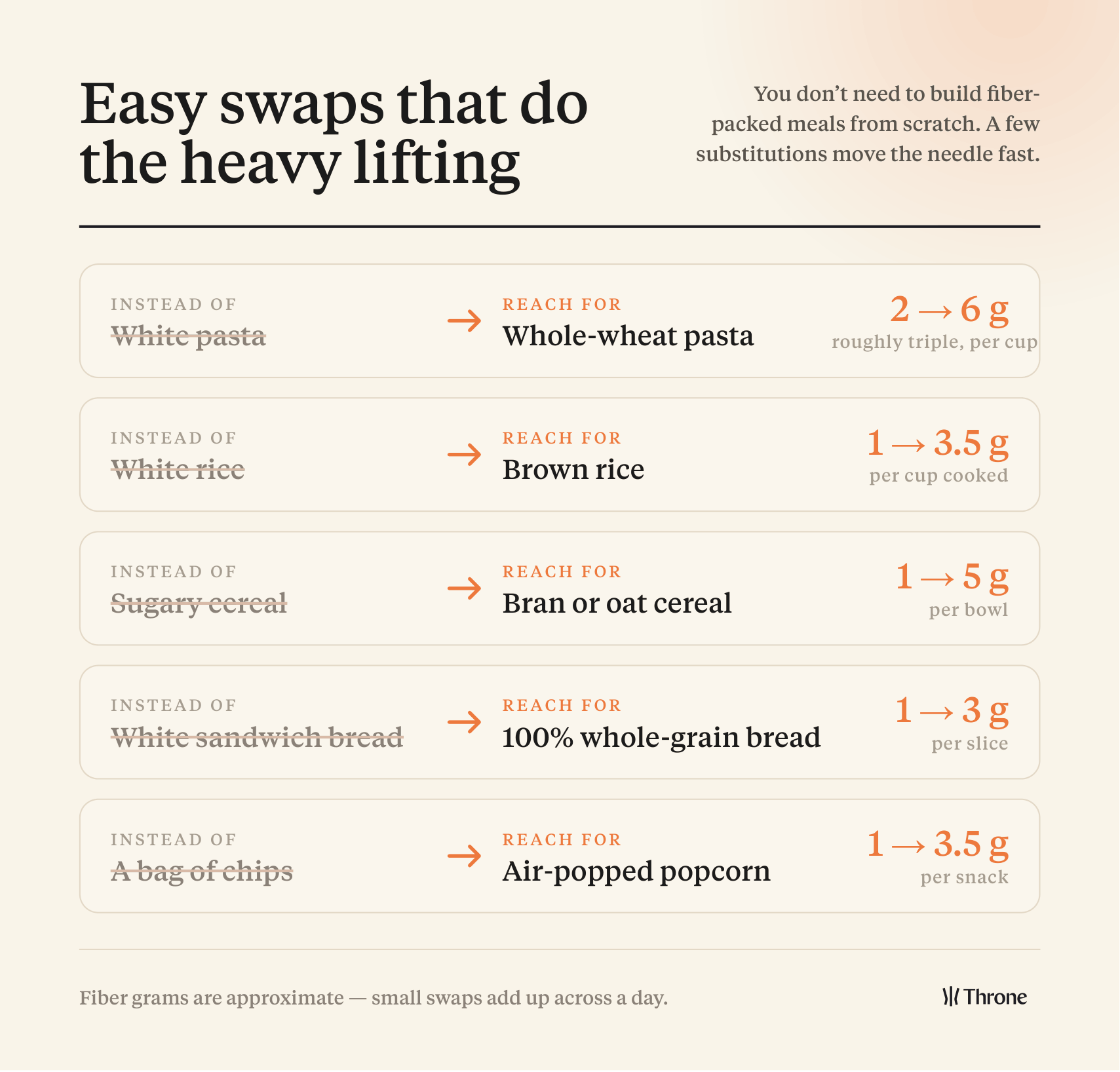
Spread these across the day rather than loading them into one meal, and the total adds up quickly without any single plate feeling heavy.
The bigger payoff
Beyond keeping you regular, fiber is one of the most protective things on your plate. Higher-fiber diets are consistently associated with a lower risk of colorectal cancer. One large dose-response meta-analysis found about a 10% lower risk for each additional 10 grams of fiber eaten per day, although observational studies cannot prove that fiber alone caused the difference.
If you're paying attention to your patterns over time, Throne can help you see whether stool consistency changed after you adjusted your diet, giving you useful information about whether to continue, slow down or discuss persistent symptoms with a clinician.
Frequently Asked Questions
Q: How much fiber do I actually need per day?
A: Around 30 grams for most adults, or more precisely about 14 grams for every 1,000 calories you eat. Most people get only half that, so even small additions help.
Q: Which fiber is best for constipation?
A: Soluble fiber dissolves in water, and some types, like psyllium, form a gel that helps regulate stool consistency. Other soluble fibers are readily fermented by gut microbes. Insoluble fiber does not dissolve and often adds stool bulk. Most plant foods contain a mixture, so variety matters more than perfectly sorting every food into one category.
Q: What's the difference between soluble and insoluble fiber?
A: Soluble fiber dissolves into a gel that softens stool, feeds gut bacteria, and steadies blood sugar. Insoluble fiber stays intact and adds bulk to move things along. Most high-fiber foods contain both, so eating a variety covers you.
Ashraf, W., Park, F., Lof, J., & Quigley, E. M. (1995). Effects of psyllium therapy on stool characteristics, colon transit and anorectal function in chronic idiopathic constipation. Alimentary Pharmacology & Therapeutics, 9(6), 639–647. https://doi.org/10.1111/j.1365-2036.1995.tb00433.x
American Institute for Cancer Research. (2026, May 12). Add more fiber to your diet: 15 tips from dietitians (C. Rosenbloom, Author). https://www.aicr.org/news/add-more-fiber-to-your-diet-15-tips-from-dietitians/
U.S. Department of Agriculture & U.S. Department of Health and Human Services. (2020). Food sources of dietary fiber. Dietary Guidelines for Americans, 2020–2025. https://www.dietaryguidelines.gov/resources/2020-2025-dietary-guidelines-online-materials/food-sources-select-nutrients/food-sources-fiber
U.S. Department of Agriculture, Agricultural Research Service. (n.d.). FoodData Central. Retrieved July 13, 2026, from https://fdc.nal.usda.gov/
DISCLAIMER: This content is for informational purposes only and is not intended as medical advice. Throne products are not medical devices and are not intended to diagnose, treat, cure, or prevent any disease. Consult your physician with any health-related questions.