
What Poop Tracking Apps Get Wrong (How To Stick With It)
If you've given up on a tracking app, it's not your fault. Many apps are built with this failure mode in place. Throne does it differently.
Written by
Thomas Nelson
Published on
July 21, 2026
Overview
If you've given up on a tracking app, it's not your fault. Many apps are built with this failure mode in place. Throne does it differently.


You downloaded an app. You logged for a week, maybe two. Then one day you didn't, and that was that.
Somewhere in there, you probably decided the problem was you. That you're just not disciplined enough to keep it up.
It's really not you, though. The app asked you to do the one thing most of us are reliably bad at, every single day, on the days you feel worst. Many people quit for the same reason, and it has almost nothing to do with willpower.
Tracking your gut is worth doing. What breaks is being asked to do all of it, by hand, forever. The bowel-movement record, what actually leaves your body and when, is one of the most repetitive and easy-to-forget parts of any log. It's also one of the easiest to hand off. That mismatch is the whole story.
Why you quit (the memory problem)
Most tracking apps ask you for three things at once: to remember what happened, to log it faithfully every day, and eventually to make sense of it.
Each of those is harder than it looks. Stack all three on one person, on their worst days, and the app quietly falls apart for a lot of people.
Memory isn't built to log information from memory. Studies that compare what people record in the moment against what they recall hours later find that the recalled version runs more severe and less accurate. One bad flare recolors the whole day, and retrospective symptom questionnaires are prone to overreporting for the same reason.
So even a diligent user, filling in the app faithfully every night, is often logging a slightly distorted version of the day. It's like writing your food diary from memory at midnight. You catch the big things, miss the small ones, and quietly exaggerate whatever stuck.
Your Body is Always Talking
You do your business. You see your data.
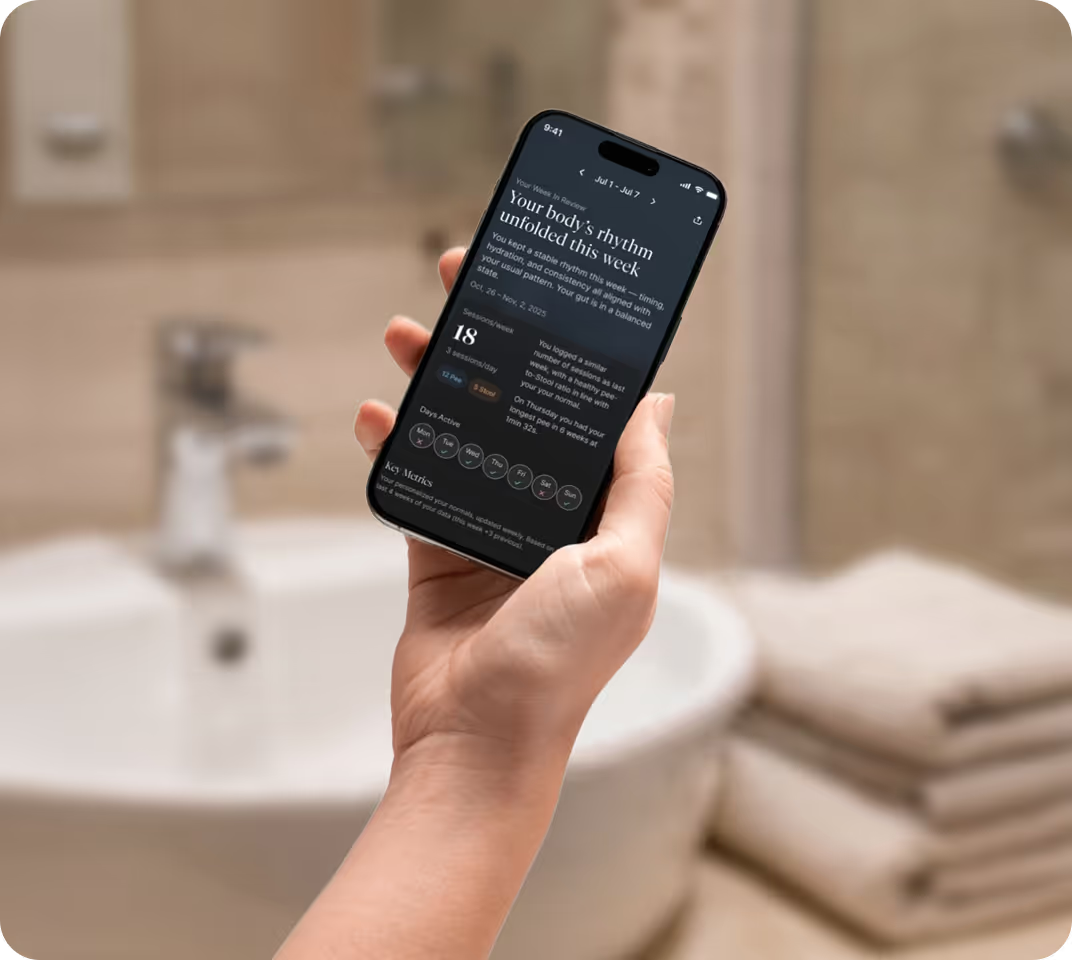
Throne is a smart sensor that clips onto your toilet and reads every session automatically — stool consistency, frequency, hydration, and regularity — without any logging. It turns the patterns you would never notice into personalized insight about your gut health and hydration.
The consistency problem
The second ask is keeping it up, and this is where many apps lose people.
Daily manual entry is friction. Every meal, every twinge, every trip to the bathroom, typed in by hand, often on a day when you would rather not think about your gut at all. Sticking with that is a recognized challenge in symptom tracking, not a personal failing.
And the data only means something if it's consistent. A log full of holes, a week here, a skipped stretch there, makes any pattern harder to trust. Which means the moment you feel worst, and log least, is the exact moment your tracker goes dark.
Logging isn't the same as fixing
Apps rarely say this outright: writing it down is not treatment.
The app is a measuring tool. It collects. On its own, logging isn't an established IBS treatment. It can support a real plan, like the reintroduction phase of a low-FODMAP diet run with a dietitian, but the app itself isn't doing anything to your gut.
That gap is where a lot of the frustration lives. People track for weeks expecting to feel better, and feel the same, because the tracking was never the treatment. It was supposed to be the map.
Even a perfect log is hard to read
Say you beat the odds. You log faithfully, in the moment, for a month. Now what?
Now comes the part apps wave past. Turning entries into "your trigger foods" is genuinely unreliable. Hand the same food-and-symptom journals to experienced clinicians and they often disagree on which foods are to blame. There is no standard method for reading these logs.
Most people with IBS do connect certain foods to their flares, so the instinct to hunt for triggers is sound. But a month of entries with no reliable way to read them can leave you more anxious, not less, staring at a chart certain the answer is in there somewhere.
What actually changes the math
The fix isn't more discipline. It's taking away the parts that fail.
Two of the three problems, memory and consistency, come down to the same thing: you having to capture the record by hand. So automate that piece.
Throne One is a smart toilet sensor that automatically records bowel-movement timing, frequency, and observed stool form. That gives you a contemporaneous bowel record without opening an app or reconstructing the day later, so you can see your baseline and how it shifts over time.
It can't diagnose IBS or name your triggers, and meals, pain, stress, and sleep still come from you, because a sensor in the bowl can't see what's on your plate or on your mind. What it does is take over the repetitive part a sensor can reliably observe, then pair that record with a coach to help you examine the wider pattern.
Are poop tracking apps ever the right call?
Sometimes, yes. Don't throw yours out on principle.
For the parts a sensor can't see, a simple log is exactly right. If you're running a structured food challenge with a dietitian, or watching how stress and sleep track with your gut, a notes app or a paper diary does the job. Some people are wired for daily logging and keep it up for years.
The point isn't that apps are useless. It's that they hand you the whole burden, including the repetitive, easy-to-forget piece a sensor could just handle, and then people blame themselves when the format gives out. So match the tool to the job. Your pain and your stress need your judgment. The timing and appearance of a bowel movement don't.
Frequently asked questions
Q: Are poop tracking apps accurate?
A: They're only as accurate as what you feed them, and you're usually logging from memory hours later. Retrospective symptom ratings tend to run heavier than what you'd record in the moment. Logging in real time helps, but that's the hardest habit to keep.
Q: Why do I keep quitting tracking apps?
A: Because daily manual entry is friction, and it asks the most on the days you feel worst. That's a recognized challenge in symptom tracking, not a discipline problem. The fix is usually to track less by hand, not to try harder.
Q: Does tracking my poop actually help?
A: It can, as the map, not the treatment. A good record helps you and your clinician spot patterns and run structured experiments like a low-FODMAP reintroduction. Logging on its own isn't an established treatment, so it works best paired with a plan.
Q: Will an app tell me my trigger foods?
A: Probably not on its own. Even experienced clinicians reading the same food-and-symptom logs often disagree on the culprits, and there's no standard method for it. Treat anything an app flags as a hypothesis to test, not an answer.
Q: How is Throne One different from a tracking app?
A: It automates the bowel-movement record, timing, frequency, and observed stool form, so that repetitive, easy-to-forget piece is captured without you logging it. It doesn't diagnose or name your triggers, and the food and lifestyle side still comes from you.
Bosman, M., Vork, L., et al. (2024). Patients with irritable bowel syndrome report higher symptom burden using end-of-day versus real-time assessment. American Journal of Gastroenterology. https://pmc.ncbi.nlm.nih.gov/articles/PMC12043265/
Wright-McNaughton, M., et al. (2019). Measuring diet intake and gastrointestinal symptoms in IBS: Validation of the Food and Symptom Times diary. Clinical and Translational Gastroenterology. https://www.ncbi.nlm.nih.gov/pmc/articles/PMC6970560/
Zia, J., et al. (2017). Inter-rater reliability of provider interpretations of IBS food and symptom journals. Journal of Clinical Medicine. https://www.ncbi.nlm.nih.gov/pmc/articles/PMC5704122/
Van den Houte, K., et al. (2024). Efficacy and findings of a blinded randomized reintroduction phase for the low-FODMAP diet in irritable bowel syndrome. Gastroenterology. https://www.gastrojournal.org/article/S0016-5085(24)00170-7/fulltext
DISCLAIMER: This content is for informational purposes only and is not intended as medical advice. Throne products are not medical devices and are not intended to diagnose, treat, cure, or prevent any disease. Consult your physician with any health-related questions.