
Does Squatting to Poop Actually Help? The Science of Toilet Posture
Does squatting or using a toilet footstool actually help you poop? Here's the real anatomy behind toilet posture, what the studies show, and who it helps most.
Written by
Thomas Nelson
Published on
July 14, 2026

Overview
Does squatting or using a toilet footstool actually help you poop? Here's the real anatomy behind toilet posture, what the studies show, and who it helps most.


Sit or squat? It's one of the oldest debates in digestive health, and unlike most wellness arguments, this one has some fascinating preliminary science behind it. The claim is that squatting, or just propping your feet on a small stool, helps you poop more easily and with less straining. It appears to help many people, although the evidence is still limited, and the reason comes down to a single muscle and the angle it creates.
If bathroom trips have felt like more of a project than they should, this may be why. Most of us were simply never told that a standard toilet can work against our own anatomy. Let's walk you through what's actually going on, and what you can do about it.
The little muscle nobody tells you about
There's a muscle called the puborectalis that loops around your rectum like a sling. It gently pulls the rectum forward and creates a bend where the rectum meets the anal canal. Doctors call that bend the anorectal angle, and it's not a defect. It's there to keep you in control, holding everything in place until you decide it's time. It works a lot like a kink in a garden hose: the bend holds back the flow until you’re ready for it.
The trouble shows up when you sit upright on a standard toilet. In that position, the muscle stays partly tightened, so the bend stays put. You end up pushing stool along a path that's still partly folded, which is exactly why sitting can take more effort.
Raising your knees can help relax the puborectalis and open the anorectal angle, giving stool a straighter path.
What the research says
The anatomy is backed by real, if still limited, evidence. In one study, 28 healthy adults each tried all three positions over six bowel movements apiece, and squatting sharply reduced both the time it took to feel fully emptied and how hard they felt they had to strain, compared with either sitting posture. The effect showed up in every volunteer and was highly statistically significant.
A more everyday version comes from a 2019 trial where people used a simple footstool for four weeks: about 90% said they strained less, roughly 70% found their trips quicker, and about two-thirds planned to keep using it. You don't need to renovate anything or install a special toilet. A footstool gives you some of the same postural benefit without changing the toilet itself.
These are small studies, so this sits in the "promising and anatomically sound" column rather than "proven beyond doubt." For most people it's inexpensive and low-risk, provided the stool is stable and the position feels comfortable.
Your Body is Always Talking
You do your business. You see your data.
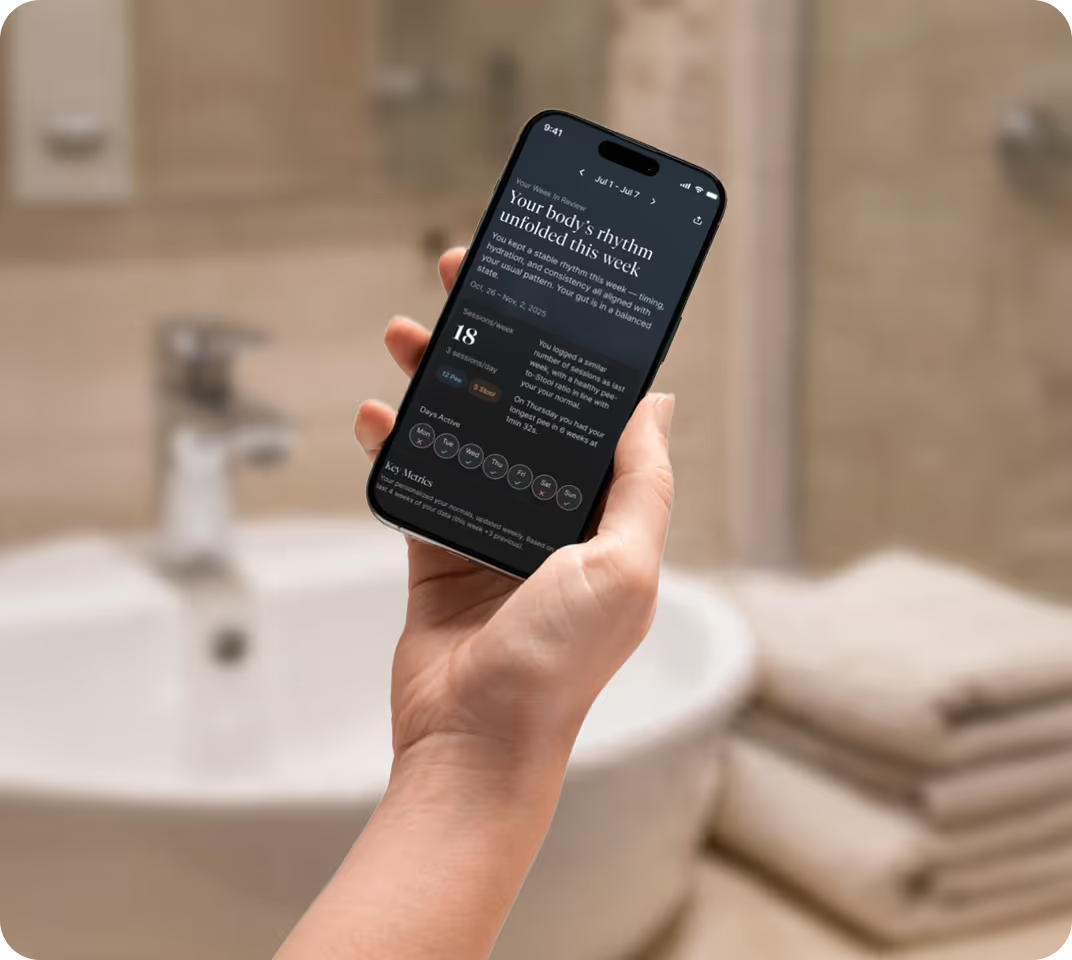
Throne is a smart sensor that clips onto your toilet and reads every session automatically — stool consistency, frequency, hydration, and regularity — without any logging. It turns the patterns you would never notice into personalized insight about your gut health and hydration.
How to do it on a normal toilet
You already have everything you need. The goal is just to lift your knees above your hips so that muscle can let go.
- Rest your feet on a small footstool, roughly 7 to 9 inches high. This is the idea behind the toilet stools you've seen. Any sturdy one does the job.
- Let your knees come up higher than your hips.
- Lean forward a little, elbows resting on your knees, and let yourself relax instead of bearing down.
That position does the work of tilting you toward a squat so your body can do the rest.
Who this helps, and who can skip it
A posture change may be most worth trying if you tend to strain, feel like you never quite finish, or deal with constipation and hard stool. Straightening that angle goes right at the "I'm pushing and nothing's happening" feeling.
It may also be worth trying if straining tends to aggravate hemorrhoids, since straining is one of the most common reasons they flare up. Less pushing means less pressure. During pregnancy or with mobility limitations, comfort and stability matter more than achieving a deep squat.
A footstool can improve the path out, but it can’t fix stool that is too hard to comfortably pass. Fiber, adequate hydration, movement, and, when needed, constipation treatment address the stool itself. Posture and stool consistency are separate parts of the same problem.
Seeing whether it helps you
The useful part of a change like this is that you can usually feel the difference: less pushing, less time and a more complete feeling afterward. If you'd like to know whether it's genuinely helping over the long run and not just on a good day, Throne quietly keeps track of the patterns that are hard to hold in your head, so you can notice whether things are actually shifting after you add a stool.
Modi, R. M., Hinton, A., Pinkhas, D., Groce, R., Meyer, M. M., Balasubramanian, G., Levine, E., & Stanich, P. P. (2019). Implementation of a defecation posture modification device: Impact on bowel movement patterns in healthy subjects. Journal of Clinical Gastroenterology, 53(3), 216–219. https://doi.org/10.1097/MCG.0000000000001143
Sikirov, D. (2003). Comparison of straining during defecation in three positions: Results and implications for human health. Digestive Diseases and Sciences, 48(7), 1201–1205. https://doi.org/10.1023/A:1024180319005
DISCLAIMER: This content is for informational purposes only and is not intended as medical advice. Throne products are not medical devices and are not intended to diagnose, treat, cure, or prevent any disease. Consult your physician with any health-related questions.