
Can't Poop but Feel Like You Have To? What's Actually Going On
Am I finished? Am I not? What’s the deal?” If you can't poop but feel like you have to, there are a few things that might be happening. Most of them aren't scary.
Written by
Thomas Nelson
Published on
July 22, 2026

Overview
Am I finished? Am I not? What’s the deal?” If you can't poop but feel like you have to, there are a few things that might be happening. Most of them aren't scary.


You're on the toilet, the urge is real, and nothing is happening. “Am I finished? Am I not? What’s the deal?”
That sensation is common, and there are real mechanisms behind it. Clinicians use two terms that help describe versions of this feeling: a sense of incomplete evacuation, meaning stool that feels left behind, and tenesmus, a persistent urge that lingers even when the rectum is nearly empty. Most of the time, it is not dangerous.
And if you've already done the fiber, the water, and the "just relax" advice, and you still feel this way, that’s worth paying attention to, because it can be a sign the problem isn't only your stool. It may involve the muscles that let it out, irritation in the rectum, or something else entirely.
The frustrating part is that sorting out what's driving it takes evidence, an actual record of what your body is doing day to day, and that record is exactly the thing that's hardest to keep when you feel like this. Here is what's going on, and what helps.
Why you feel like you have to go when nothing comes
Several things can cause this feeling, and from the inside, they feel almost the same.
One is a coordination problem at the outlet: when you push, the muscles that should relax and open don't, so little comes and you feel unfinished.
The other is irritation: an inflamed rectum can feel full and urgent even when it's basically empty, so the urge keeps firing with nothing to show for it.
These aren't the only possible explanations. Ordinary constipation or impaction, a structural issue like a rectocele or prolapse, hemorrhoids, or a change in how the rectum senses fullness can all feel pretty similar on the inside. Telling them apart is your doctor’s job, but these two are a useful place to start.
Your Body is Always Talking
You do your business. You see your data.
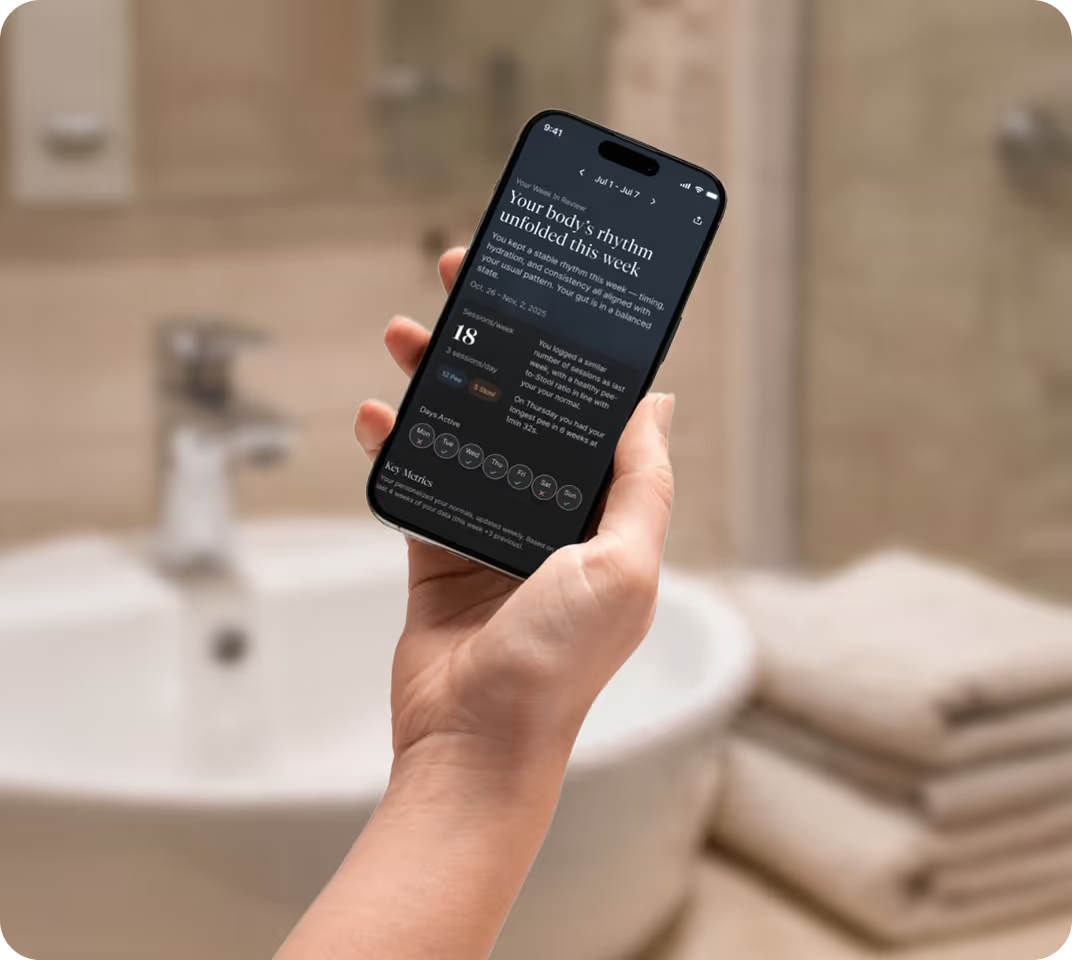
Throne is a smart sensor that clips onto your toilet and reads every session automatically — stool consistency, frequency, hydration, and regularity — without any logging. It turns the patterns you would never notice into personalized insight about your gut health and hydration.
The cause most people never hear about
Having a bowel movement takes coordination: the push from your abdomen and rectum has to rise while the pelvic floor and anal muscles relax and open. In dyssynergic defecation, that coordination breaks down. Sometimes the pelvic floor tightens or fails to relax when it should open. Sometimes the push from above is too weak. Sometimes it’s both at once. You feel the urge, you strain, little or nothing comes out, and you rarely feel like the task is done.
You can take some comfort in knowing it isn't rare. About a third of people with chronic constipation have an evacuation disorder, sometimes alongside hard stool or slow transit, and dyssynergia is a common reason.
This is largely a coordination problem, and fiber, water, and laxatives change what your stool is like, not how the muscles fire. So doing all of that and still feeling stuck doesn't mean you're doing it wrong.
In one major trial, participants entered only after longstanding constipation had failed to improve with a standardized course of fiber and laxative-based care, and testing then confirmed pelvic floor dyssynergia.
Your poop can be a part of the picture too. If yours also tends to be hard and difficult to pass, constipation and dyssynergia often happen together. But a persistent sense of not finishing, especially when the usual constipation fixes haven't helped, is something worth raising to your doctor.
So even when the stool is soft enough to pass, the outlet muscles can still fail to coordinate, so you push and little comes. More water won't fix that. Retraining the muscles can.
When it's irritation instead
The other version feels less like pushing against a wall and more like a constant, nagging need to go, even right after you've been.
That's tenesmus, and it often points to irritation inside the rectum rather than a jam at the exit. Inflammation of the rectal lining, called proctitis, can make the rectum feel full and urgent when there's nothing there. Common causes of proctitis include infections and inflammatory bowel disease, with radiation effects and, less often, a growth on the list too. IBS, where the gut and its nerves run oversensitive, can produce the sensation as well.
Tenesmus often raises concern for irritation or inflammation in the rectum, though structural and functional problems can cause it too. When inflammation is the driver, treating the cause usually relaxes the urge. Because some of the causes are serious, though, a constant urge that won't quit, especially with bleeding, pain, or weight loss, is worth getting checked by your doctor rather than waiting it out.
How doctors tell the difference
You can't reliably tell these apart from the toilet, and neither can an article. Sorting it out is worth a visit to your doctor. But take a breath, because the workup is more straightforward than you might fear.
A clinician usually starts with your history and a digital rectal exam, which can already suggest whether the pelvic floor is clenching when it should relax. If dyssynergia looks likely, common next tests are anorectal manometry and a balloon expulsion test, with defecography sometimes added when the picture is unclear or a structural problem is suspected. The balloon test is simple; manometry is more specialized and isn't available in every office.
If irritation looks like the story instead, the focus shifts to examining the rectal lining and ruling causes in or out.
What treatment looks like
Treatment depends on which problem you have, so it's worth knowing which one.
For dyssynergic defecation confirmed by testing, the treatment that has held up is pelvic floor biofeedback: a guided retraining, often a handful of sessions, that teaches the abdominal and pelvic floor muscles to work together during a bowel movement.
In a randomized trial of adults with confirmed dyssynergia, this approach clearly outperformed a laxative, and the benefit held for up to two years.
A separate trial found the improvement durable at one year. It works where more fiber didn't because it targets the coordination itself. These results come from specialized centers, and access, therapist skill, and individual response all vary.
For tenesmus from inflammation, the fix is treating the cause the workup finds, whether that's an infection or IBD. The urge tends to ease as the inflammation does.
Tracking the pattern that gets you answers
One reason this goes unsorted for so long is that the story is hard to reconstruct in a 15-minute appointment. How often are you actually passing stool, versus sitting down and passing nothing? How hard is it when it does come? Has any of that changed, and when? Most people honestly don't know, because who's keeping count? Tracking that pattern is genuinely useful; the trouble is keeping it up when you feel like this.
Some of it you can hand off. Throne is a smart toilet sensor that automatically records when bowel movements actually happen, how often, and the observed stool form, so you're not rebuilding weeks of history from memory.
On its own, that's a partial picture, because several of the details a clinician needs most for this symptom, the trips that produced nothing, how long you strained, whether you felt blocked or still unfinished, the urge that came to nothing, still need a quick note from you. Pair the two, though, and an automatic record of what happened plus a short manual note on what it felt like gives a much fuller picture than either alone, and a real baseline instead of a guess.
There are limits, though. A sensor in the bowl can't see your pelvic floor muscles, so it can't diagnose dyssynergia or tell an inflamed rectum from a jammed exit. Those take a clinician and, often, the tests above. It also can't feel the strain, the urge, or the sense of not finishing; that part is yours to record. Throne's gut health coach is built to help you line those threads up.
When to see a doctor
Feeling like you can't quite finish now and then is common and usually not dangerous. What changes the danger level is a handful of warning signs that deserve a prompt look rather than a wait-and-see:
- Blood in your stool, or bleeding from the rectum
- Unexpected weight loss
- A constant urge that won't settle or keeps getting worse, especially with pain
- Severe or steadily worsening abdominal or rectal pain
- Unexplained anemia or marked, ongoing fatigue
- New symptoms later in life, especially alongside other warning signs or if you're not up to date with colorectal cancer screening (now recommended from age 45 for average-risk adults)
- A family history of colorectal cancer or inflammatory bowel disease
None of these means the worst, they're just reasons to get it looked at sooner rather than later.
One real red flag though: if you suddenly can't pass stool or gas at all and you have belly pain, vomiting, or a swollen or distended abdomen (a fever alongside it makes it more pressing still), seek urgent emergency evaluation rather than waiting for an outpatient appointment.
Frequently asked questions
Q: Why do I feel like I still have to go right after I went?
A: Several things can do it, but two patterns are the biggest culprits. Either the muscles that should open aren't coordinating, so a little stool stays and you feel unfinished, or the rectum is irritated and firing an urge even when it's empty. Ordinary constipation, hemorrhoids, or a structural issue can feel similar too, which is why it's worth sorting out rather than guessing.
Q: I've tried more fiber and water and it hasn't helped. Why not?
A: If the problem is muscle coordination, fiber and water change your stool but not the muscles that let it out, so they often don't touch the feeling. That's a useful clue to bring to a clinician: it raises the suspicion of an evacuation problem rather than a stool problem, though the two can also coexist.
Q: Is this a sign of cancer?
A: Cancer isn't the usual explanation. But a growth in the rectum can occasionally cause a persistent urge or block evacuation, so ongoing symptoms, especially with bleeding, unintended weight loss, or if you're not up to date with colorectal cancer screening, are worth getting checked promptly.
Q: What actually fixes dyssynergic defecation?
A: For dyssynergia confirmed by testing, pelvic floor biofeedback, a short course of guided muscle retraining, has the strongest evidence and has outperformed laxative-based treatment in randomized trials, because it targets the coordination rather than the stool. A clinician confirms the diagnosis first with anorectal tests.
Q: Should I just use laxatives to force it?
A: Stimulant laxatives don't retrain coordination or treat inflammation, so forcing the issue isn't a real fix for this feeling. They can still help coexisting hard or infrequent stool, so use them under a clinician's guidance while you work out what's actually driving the sensation.
Exclusive Reader Offer
Take $50 off your Throne
Throne is the first hands-free sensor that automatically tracks your gut health, hydration, and urinary health, with every flush. Drop your email and we’ll send your $50-off code.
- Hands-free
- HSA/FSA eligible (saves 30%)
- 30-Day Battery
- 6 Private Profiles
Claim your $50
Thank you! Your submission has been received!
Oops! Something went wrong while submitting the form.
Sadeghi, A., Akbarpour, E., Majidirad, F., Bor, S., Forootan, M., Hadian, M. R., & Adibi, P. (2023). Dyssynergic defecation: A comprehensive review on diagnosis and management. Turkish Journal of Gastroenterology, 34(3), 182-195. https://www.ncbi.nlm.nih.gov/pmc/articles/PMC10152153/
Chiarioni, G., Heymen, S., & Whitehead, W. E. (2006). Biofeedback therapy for dyssynergic defecation. World Journal of Gastroenterology, 12(44), 7069-7074. https://www.ncbi.nlm.nih.gov/pmc/articles/PMC4087765/
Chiarioni, G., Whitehead, W. E., Pezza, V., Morelli, A., & Bassotti, G. (2006). Biofeedback is superior to laxatives for normal transit constipation due to pelvic floor dyssynergia. Gastroenterology, 130(3), 657-664. https://www.gastrojournal.org/article/S0016-5085(05)02274-2/fulltext
Rao, S. S., Valestin, J., Brown, C. K., Zimmerman, B., & Schulze, K. (2010). Long-term efficacy of biofeedback therapy for dyssynergic defecation: Randomized controlled trial. American Journal of Gastroenterology, 105(4), 890-896. https://pubmed.ncbi.nlm.nih.gov/20179692/
Hall, R., Patel, K., Poullis, A., Pollok, R., & Honap, S. (2024). Separating infectious proctitis from inflammatory bowel disease: A common clinical conundrum. Microorganisms, 12(12), 2395. https://www.ncbi.nlm.nih.gov/pmc/articles/PMC11678827/
Lacy, B. E., Pimentel, M., Brenner, D. M., Chey, W. D., Keefer, L. A., Long, M. D., & Moshiree, B. (2021). ACG clinical guideline: Management of irritable bowel syndrome. American Journal of Gastroenterology, 116(1), 17-44. https://webfiles.gi.org/links/PCC/ACG_Clinical_Guideline__Management_of_Irritable.11.pdf
DISCLAIMER: This content is for informational purposes only and is not intended as medical advice. Throne products are not medical devices and are not intended to diagnose, treat, cure, or prevent any disease. Consult your physician with any health-related questions.